
KHEERAN Corporation provides leading ballast investigation services throughout the USA. Our multi-frequency Ground Penetrating Radar (GPR) delivers continuous, non-invasive railway substructure assessments across the United States. As a result, railway owners get the precise condition data they need — without excavation, track damage, or service interruption.
Ballast Investigation USA: Technology and Methodology
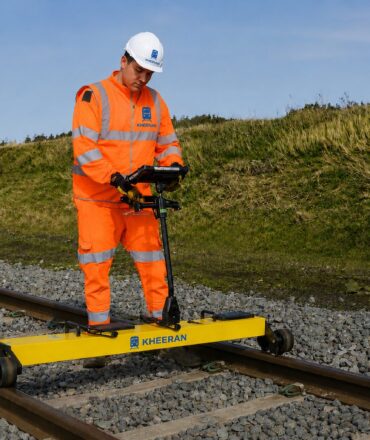
KHEERAN operates the IDS SafeRail multi-frequency GPR system. Furthermore, our hi-rail vehicles simultaneously run three antenna systems in a single pass. Two 400 MHz ground-coupled antennas provide substructure profiling. One 1 GHz air-coupled antenna delivers high-resolution fouling detection. Consequently, every survey captures a complete picture of ballast condition from shoulder to centreline. Additionally, every radar trace is synchronised with GPS positioning, railway chainage, and HD video. Therefore, every metre of surveyed US track has full traceability.
Why KHEERAN Leads Ballast Investigation Across the USA
Traditional US ballast assessment relies on widely spaced trial pits. However, these provide only isolated information. Moreover, excavation disturbs the track and requires additional labour. In contrast, KHEERAN’s continuous GPR survey covers your entire corridor in one efficient pass. As a result, you receive more data at lower cost per metre.
FRA-Aligned Results and Reporting
KHEERAN’s ballast investigation methodology aligns with Federal Railroad Administration (FRA) guidance and AREMA recommendations. Furthermore, ballast condition is classified using the Selig Fouling Index — providing a standardised, defensible basis for undercutting, cleaning, or renewal decisions. Preliminary reports are typically available within 24 hours. Contact KHEERAN today to request a ballast investigation quotation for your US railway.
Federal Standards Supporting Ballast Investigation Across the USA
KHEERAN’s ballast investigation USA services align with Federal Railroad Administration (FRA) track safety standards and AREMA recommendations. Furthermore, ballast condition classification using the Selig Fouling Index provides a nationally recognised, defensible basis for maintenance and renewal decisions. Additionally, all survey outputs are GIS-referenced and compatible with US railway asset management platforms. Consequently, US railway owners integrate ballast investigation data directly into their maintenance workflows. Moreover, preliminary results are typically delivered within 24 hours of survey completion.