Rail Track Geometry Measurement for Safer Railway Operations
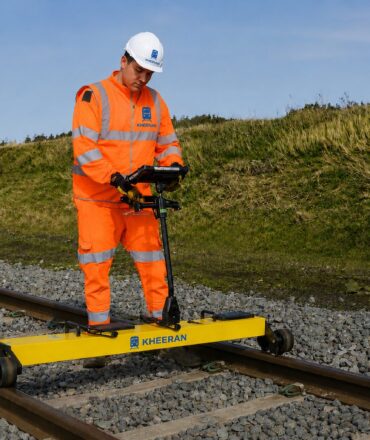
Track geometry is what keeps a train safely on the rails. KHEERAN provides continuous rail track geometry measurement to assess the condition of your railway network, identify exceptions, and support data-driven maintenance planning.
Our system measures all six key track geometry parameters at closely spaced intervals, producing a complete view of track condition, exception locations, and Track Quality Index across your corridor in a single survey campaign.
Six Track Geometry Parameters Measured Continuously
KHEERAN measures the following six parameters during continuous railway inspection:
Gauge
Gauge is the distance between the inner rail faces measured 5/8 inch below the running surface. The standard gauge is 4 ft 8½ in / 1,435 mm. Gauge measurement identifies both narrow gauge conditions, which can increase flange climb risk, and wide gauge conditions, which can lead to instability or wheel drop risk.
Horizontal Alignment
Horizontal alignment measures lateral rail deviation using mid-chord ordinate methods on 31 ft and 62 ft chords. This helps detect kinks, weld misalignment, and wave irregularities. Additionally, horizontal alignment results are essential for identifying progressive wave defects that develop between tamping cycles.
Vertical Profile
Vertical profile measures up-and-down deviation from a smooth reference line. Poor vertical profile is a major contributor to poor ride quality, fatigue damage, and accelerated track deterioration. Furthermore, poor vertical profile at joints and welds can indicate settlement or voiding beneath the sleeper.
Cross-Level
Cross-level is the height difference between the left and right rails. On curves, cross-level confirms whether the actual superelevation matches the posted operating speed. Therefore, cross-level measurement is essential on all curved sections with posted speed restrictions.
Twist / Warp
Twist, also called warp, is the rate of change in cross-level over a defined distance, commonly 31 ft. Twist is one of the most important geometry indicators for identifying derailment-related track conditions. As a result, twist exceptions are typically flagged as immediate action items under all major regulatory standards.
Curvature
Curvature measures the degree of curve at each location. It confirms whether measured alignment, superelevation, and operating speed are compatible. In particular, curvature data supports speed restriction review and curve maintenance scheduling.
Standards and Compliance
KHEERAN evaluates track geometry data against recognized railway safety and maintenance standards, including:
FRA 49 CFR Part 213 — United States
For U.S. railway operations, KHEERAN can provide exception lists aligned with FRA Track Safety Standards for Track Classes 1 to 6. Reports can include milepost, peak value, exception length, limiting class, posted class, and safety-critical two-class drops.
Transport Canada O-0-93 — Canada
In Canada, KHEERAN evaluates track geometry against Transport Canada’s Rules Respecting Track Safety. Consequently, Canadian railway operators receive exception reports formatted to meet TC O-0-93 requirements directly.
EN 13848 Series — International
Internationally, KHEERAN can report against EN 13848 requirements, including alert limits, immediate action limits, and track quality numbers. Moreover, EN-based reporting supports railway infrastructure managers operating under European safety management system obligations.
Track Quality Index Reporting
Individual exceptions identify specific defects. However, Track Quality Index, or TQI, gives a broader rating of track roughness over defined segments.
KHEERAN calculates TQI for key geometry channels, including cross-level, left and right profile, and left and right alignment. Each segment can be compared against expected performance for its track class.
A poor TQI segment should be prioritized for maintenance, even if individual exceptions appear limited. Repeat surveys also allow run-over-run comparison, showing where track quality is declining fastest.
GPR and Track Geometry Correlation
KHEERAN can combine rail track geometry measurement with Ground Penetrating Radar data in one integrated report.
This helps identify the root cause of geometry defects. For example, if a geometry exception appears at the same chainage where GPR shows fouled ballast or trapped water, the issue may be related to drainage or ballast condition rather than surface alignment alone.
This combined approach helps railway owners select the correct maintenance action the first time, therefore reducing repeated tamping and recurring defects.
Report Deliverables
KHEERAN’s rail track geometry measurement reports can include:
- Track geometry exception list in FRA ATIP TGIR format or EN/Transport Canada equivalent
- Track Quality Index summary by segment
- Track class comparison
- Run-over-run change maps for repeat surveys
- Integrated GPR and geometry correlation report
- GIS-compatible chainage files
- Maintenance priority recommendations
Why Choose KHEERAN?
KHEERAN combines railway field inspection experience, advanced measurement technology, and practical reporting designed for track engineers, asset managers, and maintenance planners.
Our goal is not only to find defects, but also to help you understand why they are happening and where maintenance funds should be spent first.
Request a Track Geometry Survey
Need reliable rail track geometry measurement for your railway network?
Contact KHEERAN today to discuss your corridor, inspection requirements, standards, and reporting format.
Request a Track Geometry Survey →