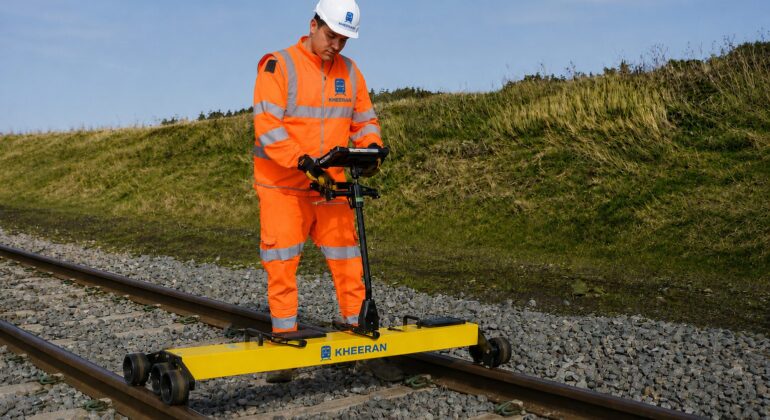

AI railway maintenance is rapidly changing how rail operators analyse and act on condition survey data. A single GPR corridor survey of a 100-kilometre mainline produces terabytes of raw radar data, while a LiDAR scan of the same corridor produces billions of points. Processed manually, these datasets would take weeks to interpret — and the output would still depend on analyst experience, fatigue, and inevitably subjective thresholds.
Consequently, leading rail research bodies such as the Transportation Technology Center, Inc. (TTCI) have increasingly prioritised machine-learning-assisted inspection in their track geometry and substructure research programmes.

AI railway maintenance tools — specifically machine-learning models trained on thousands of labelled survey datasets — can classify ballast fouling, detect geometry anomalies, and flag asset condition across a full corridor in hours, consistently and at a level of detail that human-only interpretation cannot match.
The Data Problem in Railway Infrastructure
Railway infrastructure generates more condition data than ever before. The bottleneck is not data collection — it is interpretation. Traditional analysis workflows require experienced engineers to manually review radar A-scans and B-scans, identify reflection patterns, classify anomalies, and produce written reports. This process is slow, inconsistent across analyst teams, and expensive in terms of engineer time.
AI addresses all three limitations.
How Machine Learning Works in GPR Ballast Analysis
Ballast fouling produces characteristic patterns in GPR data. Clean ballast — with high air-void content — generates strong scattering and clear layer boundaries. Fouled ballast dampens radar energy and blurs layer interfaces. Water-saturated zones produce distinctive high-amplitude reflections at the fouling front.
A machine-learning model trained on labelled GPR datasets learns to recognise these patterns directly from the raw radar signal, outputting fouling category at each survey point, clean-ballast thickness as a continuous depth profile, trapped water and ballast pocket flags, and anomaly scores for unusual signal patterns requiring human review.
Critically, the model’s classifications are consistent regardless of survey volume. The 1,000th kilometre is classified with the same threshold as the first.
Calibration: Where AI Meets Ground Truth
No machine-learning model is better than the data it was trained on — and ballast is not uniform. Granite, limestone, trap rock, and recycled ballast each have different dielectric properties. Kheeran addresses this through field calibration: targeted excavation samples are collected and subjected to sieve analysis, and the model’s classification thresholds are adjusted to the local ballast type before production data is processed.
AI in LiDAR Processing
A high-density LiDAR corridor survey produces a raw point cloud with no semantic information. Deep-learning models trained on annotated railway point clouds perform classification automatically, separating asset classes and populating attribute tables with derived measurements — rail head location, platform height and offset, vegetation encroachment distance, signal chainage and offset. What would take a team of analysts weeks is produced in hours.
However, predictive maintenance requires high-quality labelled training data from previous survey campaigns. Therefore, the value of predictive models increases with each successive survey run — making early adoption of continuous AI railway maintenance analysis a compounding investment.
Predictive Maintenance: From Condition Snapshot to Deterioration Forecast
When multiple survey runs are available for the same corridor, machine-learning models can forecast how quickly a segment will deteriorate to a maintenance intervention threshold — based on current condition, historical deterioration rate, traffic loading, and environmental factors.
This shifts maintenance planning from reactive (respond to defects after they appear) through preventive (maintain on a fixed schedule) to predictive (intervene at the optimum point in each segment’s deterioration curve). For network operators with constrained maintenance budgets, predictive models concentrate spend where it generates the most value.
What Kheeran’s AI Integration Delivers
Automated fouling classification from multi-frequency GPR data, calibrated to site ballast. Anomaly flagging that surfaces unusual signal patterns for engineer review. Automated point cloud classification converting raw LiDAR data into structured asset inventories. Run-over-run change detection quantifying deterioration at the segment level. And report generation that translates model outputs into maintenance language — undercutting priority zones, tamping segments, drainage remediation recommendations.
The goal is not to replace railway engineering judgment. It is to ensure that engineering judgment is applied to maintenance decisions — rather than to repetitive pattern recognition that machines do faster and more consistently.
Learn more about Kheeran’s AI integration or contact us to discuss your survey requirements.