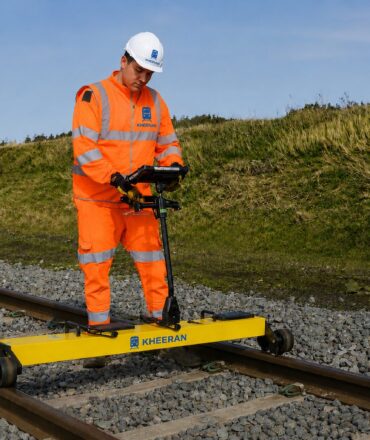

Ground penetrating radar technology has transformed railway maintenance. KHEERAN Corporation operates the IDS SafeRail multi-frequency GPR system — one of the world’s leading platforms for non-invasive railway substructure investigation. As a result, railway maintenance teams receive continuous, accurate condition data without excavation or service disruption.
Ground Penetrating Radar for Railway Maintenance: How It Works
Ground penetrating radar works by transmitting electromagnetic pulses into the track structure. Furthermore, these pulses reflect off layer boundaries — between ballast and sub-ballast, or between sub-ballast and formation. Consequently, the reflections reveal substructure geometry, layer thicknesses, and material properties. Additionally, changes in signal character identify fouling, moisture, voids, and other substructure defects.
Multi-Frequency GPR for Maximum Data Quality
KHEERAN’s system operates at multiple frequencies simultaneously. Two 400 MHz ground-coupled antennas provide deep substructure profiling — penetrating to approximately 2 metres. Moreover, one 1 GHz air-coupled antenna delivers high-resolution fouling detection near the surface. Therefore, a single survey pass captures both broad substructure geometry and fine-detail ballast condition — data that single-frequency systems cannot provide.
Supporting the Full Maintenance Cycle
Furthermore, KHEERAN’s GPR data supports every stage of the railway maintenance cycle — from routine condition monitoring and tamping optimisation to undercutting scheduling, drainage assessment, and capital renewal planning. As a result, railway maintenance teams have the continuous, reliable data they need to manage their track assets proactively. Contact KHEERAN today to learn how ground penetrating radar can improve your railway maintenance program.
Recognised Standards Behind Ground Penetrating Radar for Railway Maintenance
KHEERAN’s use of ground penetrating radar for railway maintenance aligns with guidance from AREMA, the Federal Railroad Administration (FRA), and Transport Canada. Furthermore, KHEERAN’s GPR methodology is validated against established non-destructive testing practices for railway substructure inspection. Additionally, ballast condition is classified using the Selig Fouling Index — the internationally recognised standard for GPR-based railway maintenance assessment. Consequently, railway owners receive ground penetrating radar data that meets regulatory and engineering standards for maintenance planning and capital investment decisions.