
Railway ballast fouling is one of the most common and costly challenges in railway maintenance. KHEERAN Corporation specialises in the detection of railway ballast fouling using advanced multi-frequency GPR technology. As a result, railway owners can identify fouled zones early, plan targeted maintenance, and prevent premature track deterioration.
Railway Ballast Fouling: Main Causes
Ballast fouling occurs when fine particles fill the voids between ballast stones. Furthermore, the main sources of fouling material include ballast breakdown from repeated loading, infiltration of clay and silt from the formation below, and contamination from cargo spillage above. Consequently, as voids fill, drainage capacity reduces, moisture is trapped, and track support weakens. Moreover, once fouling reaches a critical level, geometry defects and differential settlement follow rapidly.
Detecting Ballast Fouling with GPR
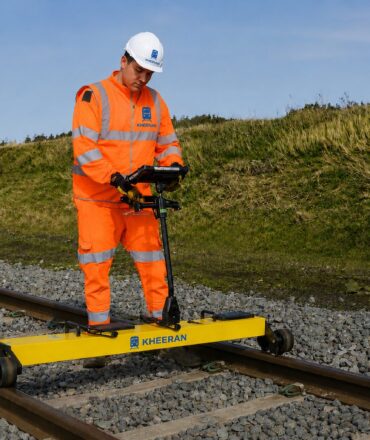
KHEERAN uses multi-frequency Ground Penetrating Radar to detect railway ballast fouling continuously along the survey corridor. Furthermore, clean ballast and fouled ballast have different electromagnetic properties — and GPR detects this difference accurately. Additionally, KHEERAN’s AI-powered signal processing classifies fouling severity using the Selig Fouling Index. Therefore, fouling zones are mapped precisely, without excavation or service disruption.
Prevention and Maintenance Strategies
Early detection of railway ballast fouling enables targeted intervention — tamping, undercutting, ballast cleaning, or full ballast renewal — before fouling becomes severe. Moreover, regular GPR monitoring establishes condition trends, helping railway owners anticipate deterioration and schedule maintenance proactively. As a result, lifecycle costs are reduced and unplanned track closures are minimised. Contact KHEERAN today to arrange ballast fouling detection for your railway.
Engineering Standards for Railway Ballast Fouling Detection
KHEERAN’s railway ballast fouling detection methodology aligns with internationally recognised standards published by AREMA and supported by FRA and Transport Canada guidance. Furthermore, fouling condition is classified using the Selig Fouling Index — the internationally recognised engineering standard for quantifying railway ballast fouling severity. Additionally, KHEERAN’s fouling detection reports include maintenance priority rankings that support evidence-based decisions on cleaning, undercutting, and renewal. Consequently, railway owners receive railway ballast fouling detection outputs that are defensible for engineering decisions, regulatory compliance, and capital investment planning.