
KHEERAN Corporation provides expert ballast investigation for port and terminal railways. Port and terminal railways face unique substructure challenges — heavy container and bulk cargo loads, frequent stop-start operations, and contamination from cargo spills. As a result, ballast degradation at ports is often more severe and more localised than on mainline railways.
Ballast Investigation at Ports and Terminals: Unique Challenges
Port railway track experiences repeated heavy axle loading at slow speeds. Furthermore, stop-start operations create significant dynamic impact forces at the same track locations. Consequently, differential settlement and localised fouling develop rapidly at loading points, crossing loops, and connection tracks. Moreover, cargo contamination — from grain, coal, mineral ores, or container wash-down — adds to ballast degradation.
Non-Invasive GPR Assessment
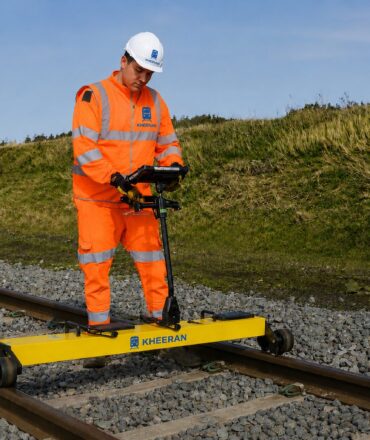
KHEERAN’s multi-frequency GPR technology maps ballast fouling and substructure conditions without disrupting port operations. Furthermore, our hi-rail inspection vehicles access all areas of the port railway network. Additionally, three GPR antenna systems operate simultaneously — providing both deep substructure profiling and high-resolution fouling detection in a single survey pass. Therefore, port railway operators receive complete, continuous substructure data across their entire track network.
Targeted Maintenance for Port Railway Efficiency
KHEERAN delivers continuous fouling maps, ballast thickness profiles, and maintenance priority recommendations specific to your port railway. Moreover, critical loading points and high-wear zones are identified clearly. As a result, maintenance teams can target undercutting, tamping, and renewal resources at the locations where operational reliability depends on it most. Contact KHEERAN to discuss ballast investigation for your port or terminal railway.
Engineering Standards for Ballast Investigation on Port Terminal Railways
KHEERAN’s ballast investigation for port terminal railways aligns with AREMA engineering standards and applicable national railway safety requirements. Furthermore, condition classification using the Selig Fouling Index provides a defensible engineering basis for tamping, undercutting, and renewal decisions under heavy freight axle loads. Additionally, all KHEERAN survey deliverables for port terminal railways are GIS-referenced and compatible with port and logistics asset management systems. Consequently, port railway operators can integrate ballast investigation data directly into infrastructure maintenance and capital planning workflows.