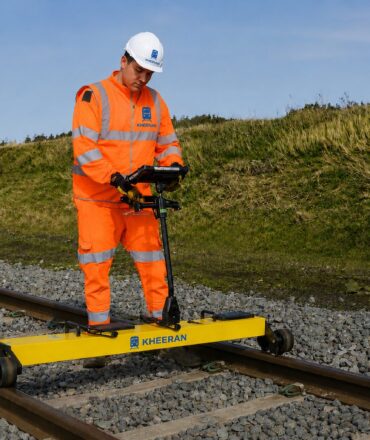


Ballast is the layer of coarse, angular stone that holds track geometry and drains water away from the track structure. New ballast is full of air voids between the stones. As track ages, those voids fill with fine material — broken-down stone, windblown fines, coal dust, or pumping subgrade — a process called fouling. Fouled ballast cannot drain, loses strength, and lets track geometry deteriorate, eventually raising the risk of derailment.
Why fouling is hard to measure
Traditional inspection means digging trial pits or drilling cores — slow, disruptive, and revealing only isolated points. Between those points, the condition of the track is a guess. Ground Penetrating Radar (GPR) changes that by giving a continuous picture of the substructure along the entire route, with no excavation.
Two proven methods
The railway industry uses two complementary GPR techniques, both validated in the U.S. Federal Railroad Administration’s independent multi-vendor evaluation at the Transportation Technology Center. Void-scattering analysis uses high-frequency 2 GHz antennas: the air voids in clean ballast scatter the radar energy strongly, while fouled ballast — its voids filled with fines — scatters little. Frequency-spectrum (dielectric dispersion) analysis uses 400 MHz antennas: fines and moisture shift the frequency content of the returned signal in a measurable way.
The right antenna for each question
2 GHz antennas resolve fouling in the critical top ~75 cm and are largely insensitive to moisture, so results hold across weather. 400 MHz antennas penetrate 1–2 m for full substructure layering. Running both in one survey delivers fouling detail and deep structure at once — and lets two independent methods cross-check each other.
Calibration matters
Radar classifications are only as good as their calibration. Both methods are tied to sieve analysis of ballast samples, reported against recognised indices such as the Selig Fouling Index or AREMA gradation envelopes — so results plug straight into existing maintenance standards.
Want to know what lies beneath your track? Talk to KHEERAN about a survey.