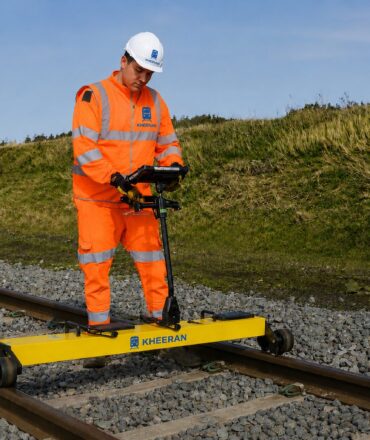

KHEERAN Corporation provides trusted railway inspection services to railway owners, operators, and contractors worldwide. We combine multi-frequency Ground Penetrating Radar (GPR), LiDAR corridor scanning, precision track geometry measurement, and AI-powered data analytics. As a result, clients receive the most comprehensive railway condition assessment available — all from a single efficient hi-rail survey pass.
KHEERAN Railway Inspection Services: Our Capabilities
KHEERAN’s railway inspection capabilities cover every layer of the track structure. Furthermore, our GPR system maps ballast fouling, clean ballast thickness, sub-ballast layers, and formation interfaces. Additionally, our LiDAR scanners capture 3D corridor geometry including clearances, drainage, and embankment conditions. Consequently, nothing in your track asset goes unassessed in a KHEERAN inspection survey.
AI-Powered Data Processing and Reporting
KHEERAN’s inspection data is processed by our AI-powered analytics platform. Machine learning models classify GPR condition zones automatically. Furthermore, geometry findings are correlated with substructure data to identify root causes of track deterioration. Therefore, your maintenance team receives clear, prioritised condition maps and maintenance recommendations — not raw data files requiring further interpretation. As a result, you can act on findings immediately.
Serving Clients Across North America and Internationally
Moreover, KHEERAN serves Class 1 freight railways, commuter transit agencies, mining operations, industrial railways, and port networks across North America, Australia, South America, and internationally. Furthermore, our methodology aligns with FRA, Transport Canada, and AREMA standards — giving clients a globally consistent, defensible engineering basis for maintenance decisions. Contact KHEERAN today to discuss your railway inspection project.
Industry Standards Behind KHEERAN Railway Inspection Services
KHEERAN railway inspection services align with recognised international railway engineering standards, including guidance from AREMA, the Federal Railroad Administration (FRA), and Transport Canada. Furthermore, all KHEERAN inspection methodologies are validated against established engineering practices for GPR, LiDAR, and geometry measurement. Additionally, ballast condition classification uses the Selig Fouling Index — the internationally recognised standard for ballast assessment. Consequently, railway owners worldwide receive inspection results that meet internationally recognised engineering standards and are defensible for regulatory compliance, maintenance planning, and capital investment decisions.