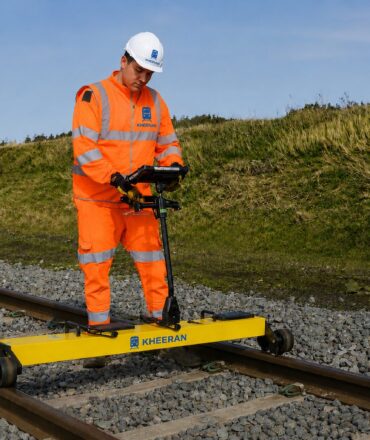

Undetected track geometry defects are one of the leading causes of railway incidents. KHEERAN Corporation provides precision track geometry defect detection and assessment services — identifying gauge, cross-level, alignment, profile, and twist irregularities across entire railway corridors. As a result, railway owners can address defects proactively, before they escalate into safety-critical failures.
Track Geometry Defects: Types and Causes
Track geometry defects take several forms. Gauge defects occur when the distance between rail heads deviates from the design standard. Furthermore, cross-level defects arise when one rail sits higher or lower than the other across the track. Additionally, alignment defects are horizontal deviations from the design centreline. Consequently, each type creates different dynamic loading patterns — and each has a different root cause, typically linked to substructure deterioration.
Continuous Detection at Operational Speeds
KHEERAN’s precision geometry scanning systems measure all critical parameters continuously at operational survey speeds. Therefore, every deviation along the corridor is captured — not just sampled at isolated locations. Furthermore, all measurements are synchronised with GPS and railway chainage, so every defect is precisely located and traceable. As a result, maintenance teams know exactly where to intervene.
Integrated with Substructure Assessment
Moreover, KHEERAN correlates geometry defect data with multi-frequency GPR ballast investigation results. Consequently, the underlying substructure cause of each geometry defect can be identified directly. This integrated approach supports targeted remediation — fixing root causes rather than applying repeated surface treatments. Contact KHEERAN today to arrange track geometry defect detection and assessment for your railway.
Regulatory Framework for Track Geometry Defects Detection and Assessment
KHEERAN’s track geometry defects detection and assessment services align with track safety standards set by the Federal Railroad Administration (FRA), Transport Canada, and AREMA. Furthermore, all geometry defect classifications and exceedance flags are referenced directly to applicable regulatory thresholds — giving railway owners a clear, defensible basis for maintenance scheduling and priority intervention. Additionally, KHEERAN’s assessment reports include defect prioritisation rankings aligned with regulatory intervention timelines. Consequently, railway owners can plan remediation work with confidence, knowing every geometry defect detected meets the standards required by their regulatory authority.