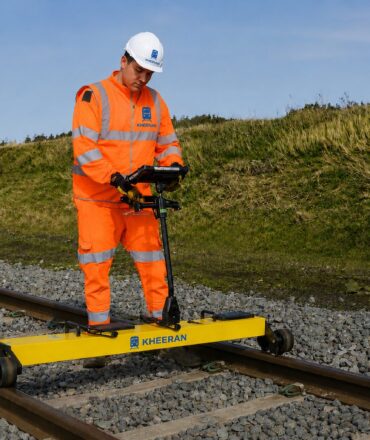

Railway ballast — the crushed stone aggregate packed between and beneath the sleepers — isn’t glamorous. But for everyone responsible for maintaining the track, ballast fouling GPR detection is one of the most important capabilities in modern railway maintenance. When ballast fouls, it stops draining. When it stops draining, geometry deteriorates and derailment risk rises. According to AREMA, fouled ballast is a contributing factor in a substantial proportion of track geometry exceptions.
What is ballast fouling?
Ballast fouling is the accumulation of fine material in the void space between aggregate particles. Those voids provide drainage and structural interlock. Once fines fill them, the ballast mass behaves more like saturated soil than a free-draining structural layer. Furthermore, fouled ballast that retains water during freeze-thaw cycles causes accelerated track bed deterioration.
Why surface inspection misses it
The track that is failing often looks perfectly normal from the surface. Fouling develops from the bottom of the ballast layer upward — by the time it is visible or detectable by tamping resistance, the condition is already advanced. However, ballast fouling GPR detection identifies the problem long before surface symptoms appear.
How GPR detects ballast fouling
Ground Penetrating Radar transmits radar pulses into the substructure and records the reflected signals. Clean ballast has high air void content and low dielectric, producing a characteristic scatter pattern. Fouled or water-saturated ballast has a higher dielectric constant, dampening the signal and producing a distinct reflection signature. Additionally, multi-frequency GPR provides both shallow fouling classification and deep subgrade penetration in a single hi-rail pass.
Ballast fouling GPR detection in practice
A Kheeran GPR survey delivers chainage-referenced fouling profiles within 24 hours of survey completion — no possession beyond a standard hi-rail access window, no excavation required. The result is a complete condition map of your corridor that maintenance planners can use immediately to prioritise undercutting and shoulder cleaning.