Track geometry is what keeps a train on the rails — literally. The way a rail deviates from a perfectly smooth, perfectly gauged, perfectly level ideal determines how the vehicle behaves: whether it rides comfortably or rides roughly, whether it’s safe at the posted speed or requires restriction, whether it needs routine maintenance or urgent intervention.
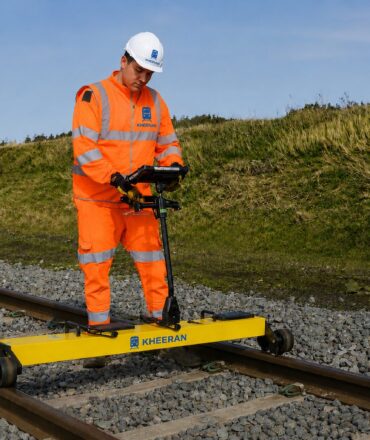
Modern track geometry systems measure this deviation continuously, at speed, across entire networks — producing a complete picture of the track’s condition that no amount of manual inspection can replicate. But the data is only as useful as the analysis applied to it. This guide explains what the parameters mean, how the standards work, and how to turn a geometry dataset into a maintenance decision.
The six primary track geometry parameters
Every track geometry measurement system captures some combination of the following six parameters, all measured at closely spaced intervals (typically every foot or every 25 cm):
Gauge is the distance between the inner faces of the two rail heads, measured 5/8 inch (16 mm) below the running surface. Standard gauge is 4 ft 8½ in (1,435 mm). Narrow gauge (track too tight) risks wheel flange climbing; wide gauge creates instability and wheel drop risk. Both are tightly regulated in every standard.
Horizontal alignment is the lateral deviation of the rail from a smooth reference chord. It catches kinks, misalignment at joints and welds, and wave-like irregularities in curves. The FRA uses mid-chord ordinate (MCO) measurement over 31-ft and 62-ft chords, with each targeting a different wavelength of irregularity.
Vertical profile is the up-and-down deviation of the rail from a smooth reference — capturing high spots, dips, joints, and periodic roughness. Profile drives vertical acceleration and is the dominant contributor to ride quality degradation and fatigue damage to rail and rolling stock.
Cross-level is the height difference between left and right rails measured perpendicular to the track. On tangent track it should be zero; on curves it is the superelevation (cant) designed to balance centrifugal force at the posted speed. Excess or deficit cross-level against the posted speed creates a curve that either forces speed restriction or risks vehicle instability on the high-speed side.
Twist (warp) is the rate of change of cross-level over a short distance — typically 31 feet under FRA standards. A vehicle traversing a twist experiences a dynamic see-saw motion that can unload a wheel. High twist is consistently one of the most derailment-significant geometry parameters in FRA defect statistics.
Curvature is the degree of curve at each track position, computed from alignment readings. It’s used to check that the posted superelevation and running speed are compatible with the actual measured curvature, and to flag where the combination of curvature, elevation and speed creates a limiting condition.
How the FRA Track Safety Standards work
In the United States, the Federal Railroad Administration’s Track Safety Standards (49 CFR Part 213) define minimum geometric requirements for each Class of Track. Track is classified 1–6 (or above, for high-speed rail) based on the maximum authorized operating speed. Higher-class track carries stricter tolerances because the dynamic effects of geometry irregularities increase with speed.
An “exception” is reported when a measured parameter exceeds the applicable limit (plus a 0.10-inch grace allowance) for two or more consecutive sample points. The FRA’s exception list format — used by ATIP geometry cars and reflected in KHEERAN’s reports — records: milepost and footage, parameter name, peak value, exception length, survey speed, tangent/spiral/curve designation, Limiting Class and Posted Class.
The most serious flag is a “two-class drop” — where conditions are so severe that the track would need to be classified two or more classes below its current posting to achieve compliance. Two-class drops are tracked separately as safety-critical indicators.
Track Quality Index — rating the whole rather than the parts
Individual exceptions identify specific defects. The Track Quality Index (TQI) summarizes the overall roughness of a track segment as a single number, enabling comparison across the network and over time.
The FRA TQI is based on the “space curve” concept: for each 528-foot segment, the actual measured geometry traces a three-dimensional path that is longer than a perfect track would trace. The difference between the measured path length and the ideal path length indicates roughness. Higher TQI values mean rougher track.
TQI is computed for each of five geometry channels (cross-level, left and right profile, left and right alignment) and the result is compared against the national average for that track class. A segment rated “poor” within its class is deteriorating faster than average — and warrants closer attention in the maintenance programme.
The real power of TQI is in trend analysis. A segment moving from ‘good’ to ‘average’ in one survey cycle, and then toward ‘poor’ in the next, is telling you something about the rate of degradation — and gives you a forecast of when it will next exceed a compliance threshold.
Run-over-run comparison: knowing not just where but how fast
A single geometry survey answers: where is the track now? Repeat surveys answer the more valuable question: how fast is it degrading? Run-over-run comparison identifies segments where TQI is declining rapidly, or where an exception that was borderline last survey has now crossed the threshold — allowing maintenance to be prioritized to the highest-rate-of-change sections, not just the worst current performers.
Why geometry data needs substructure context
Track geometry exceptions have two fundamentally different causes, and the maintenance response differs completely.
Surface geometry faults — wear at the running surface, joint bar settlement, top-down deterioration — respond to surfacing, tamping, rail grinding and joint maintenance. Substructure geometry faults — caused by fouled ballast that can’t hold position, trapped water softening the subgrade, or differential settlement in the formation — will re-emerge weeks or months after tamping because the root cause was never addressed.
KHEERAN pairs geometry survey data with GPR substructure data in a combined report. A geometry exception at a chainage where GPR shows heavily fouled ballast or a trapped-water pocket is flagged differently: it’s a drainage or undercutting problem, not a surfacing problem. Maintenance planners get the root cause, not just the symptom — and maintenance budgets go to the right intervention the first time.
Know where your track stands — and why it’s failing where it is. KHEERAN geometry surveys are evaluated against FRA 49 CFR 213, Transport Canada and EN 13848 — delivered in the format your engineering team expects. → Request a Track Geometry Survey