
Railway ballast fouling is one of the leading causes of track geometry deterioration and substructure failure on freight and passenger lines worldwide. Ballast is the layer of crushed stone that holds railway ties (sleepers) in place, drains water away from the track, and distributes the enormous load of passing trains into the subgrade below. When ballast is clean and angular, it does all three jobs well. When railway ballast fouling occurs, it does none of them reliably — and the consequences range from accelerated track deterioration to derailment risk.
Furthermore, the Federal Railroad Administration (FRA) research on ballast fouling confirms that substructure condition is a primary driver of track geometry deterioration on North American mainlines.
Understanding what causes railway ballast fouling and how to detect it early is one of the most important decisions a railway maintenance team makes each season.
What Causes Ballast Fouling?
Ballast fouling is the accumulation of fine material within the voids between aggregate particles. Those voids are what give clean ballast its structural integrity and drainage capacity. Once fines fill them, the ballast mass behaves more like a saturated soil than a free-draining structural layer.
There are five primary fouling sources:
Ballast breakdown. Repeated loading fractures ballast particles over time, generating fines from within the layer itself. This is the most common fouling mechanism on high-tonnage mainlines.
Infiltration from above. Coal dust, grain residue, and other freight commodities settle through the ballast surface. Lines carrying open-top freight are particularly susceptible.
Subgrade pumping. Weak or saturated subgrade material is forced upward into the ballast under dynamic load. This is often the hardest fouling to address because it recurs rapidly after undercutting if the drainage or formation problem is not fixed.
Sleeper wear. Concrete sleeper abrasion and timber sleeper decay both generate fine material that migrates downward into the ballast matrix.
Windblown or waterborne contamination. Fine soil, vegetation debris, and organic material carried by wind or surface water add to fouling in exposed corridors.
In addition to the structural risks described above, fouled ballast accelerates the overall cost of track ownership. Therefore, early detection through non-destructive testing is the most cost-effective response available to maintenance planners.
Why Fouled Ballast Is a Maintenance Priority
The consequences of fouled ballast compound over time:
How GPR Detects Ballast Fouling Without Excavation
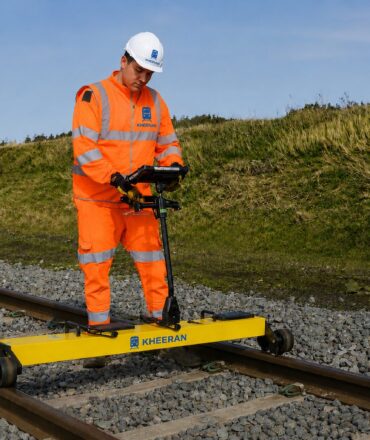
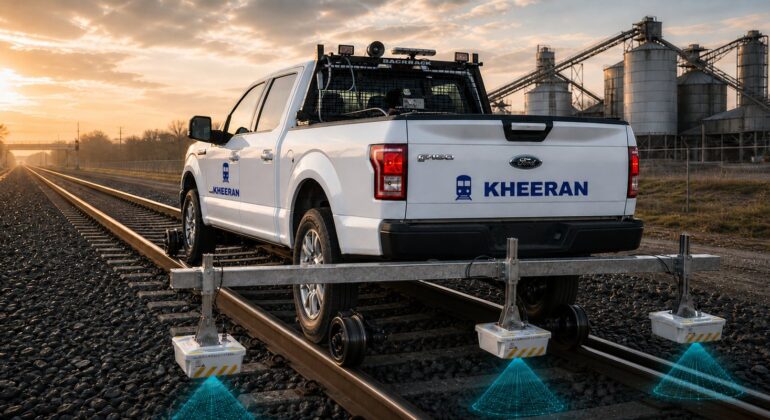
Ground Penetrating Radar (GPR) is the industry-standard tool for continuous, non-destructive ballast investigation. A hi-rail vehicle carrying GPR antenna arrays travels the track at normal speed, transmitting radar pulses into the substructure and recording reflected signals. The reflection pattern reveals the dielectric contrast between clean ballast (low dielectric, high air void) and fouled or wet ballast (high dielectric, water-saturated).
Multi-frequency GPR delivers a complete picture:
2 GHz antennas resolve the upper ballast layer in fine detail, identifying fouling zones across the track centre and both shoulders in a single pass.
400 MHz antennas penetrate deeper, mapping clean-ballast thickness, subgrade interfaces, and trapped water pockets not visible at high frequency.
The result is a continuous chainage-referenced profile showing fouling category (clean through highly fouled), clean-ballast depth, and water flags — without a single excavation.
Calibration is critical. Kheeran cross-checks radar classifications against targeted calibration samples with sieve analysis, so fouling categories reflect your actual ballast — not a generic model.
What the Survey Delivers
A Kheeran ballast investigation provides fouling categories by chainage for track centre and both shoulders, clean-ballast thickness profiles, trapped-water and ballast-pocket flags, GIS condition maps, statistical summaries by segment, and prioritised recommendations for undercutting, shoulder cleaning, and drainage remediation. First-pass results are available within 24 hours of survey completion.
When Should You Survey?
Ballast condition is not visible from the surface. Geometry defects are a lagging indicator — by the time geometry is failing, ballast fouling has typically been severe for some time. Proactive GPR surveys allow maintenance budgets to be targeted at segments that actually need intervention.
Contact Kheeran to scope your next ballast investigation survey.